
For most first-time tourists in Bhutan, the honest answer is: all four – but for very different reasons. Paro is for the hike you’ll never forget, Thimphu is for understanding the country, Punakha is for the view that stops you mid-sentence, and Phobjikha is for everyone who wants to find the part of Bhutan that hasn’t been written about yet.
Every experienced tour operator in Bhutan will tell you the same thing – the classic triangle of Paro, Thimphu, and Punakha exists because it works. These three places together give you a complete picture of the country: its culture, its architecture, its landscapes, and its spirituality.
But Phobjikha? That’s the one people come back raving about. The one they didn’t expect to be their favourite.
This guide breaks down what each destination actually offers – not just what’s in the brochure, but what kind of traveler each one suits best.
Paro - For the Photo That Made You Want to Come Here
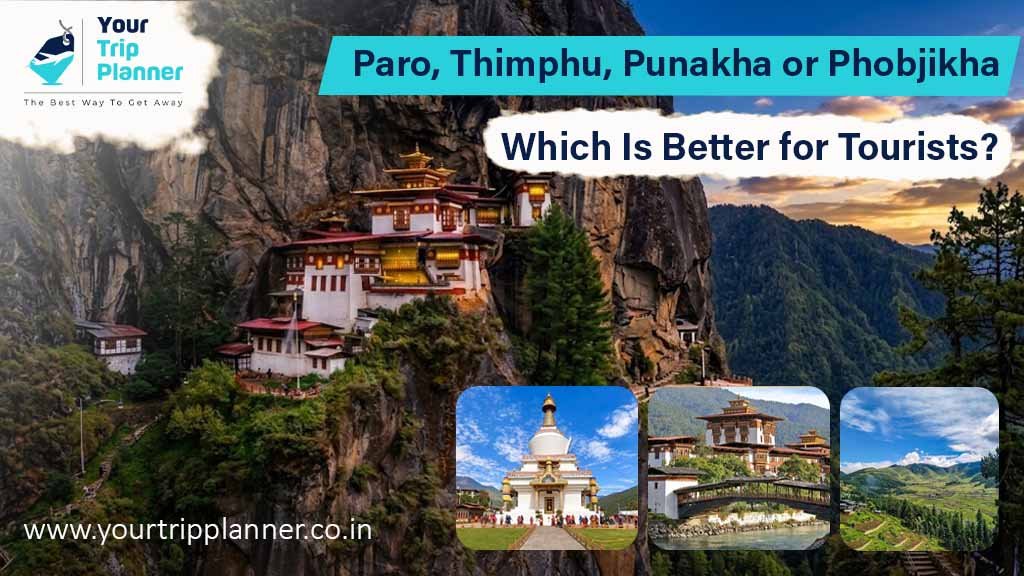
Paro is the first place most tourists in Bhutan see – it’s where the airport is – and it also happens to contain the single most iconic sight in the country: Tiger’s Nest Monastery, perched on a cliff face at 3,120 metres.
You’ve seen the photograph. The monastery clinging to the rock. The prayer flags below. The pine forest spreads down the valley.
It looks like it was designed by someone who understood exactly how dramatically a building could be placed. And then you hike up and realise it looks even better from directly below.
The Tiger’s Nest trek takes 2 to 4 hours depending on your pace. Start before 8am – the light is better, the trail is cooler, and you’ll have the viewpoints largely to yourself. By 11am it gets busy. The hike isn’t technical but it’s real – don’t underestimate it, and don’t wear sandals.
Beyond Tiger’s Nest, the Paro Valley itself is worth a slow morning. The Rinpung Dzong overlooking the valley, the old watchtower, the weekend market – none of them are as famous as the monastery, but all of them are worth your time.
Paro is best for:
- First-time visitors to Bhutan
- Hikers and trekkers
- Photographers
- Anyone whose primary Bhutan goal is Tiger’s Nest
What Paro doesn’t have:
- City energy – it’s quiet, which is also its appeal
- The cultural depth of Thimphu
- The landscape drama of Punakha
Key facts:
- Altitude: 2,250 metres
- Tiger’s Nest altitude: 3,120 metres
- Drive from Thimphu: approximately 1.5 hours
- Best season: March–May and September–November
Thimphu - For Understanding What Bhutan Actually Is
Thimphu is Bhutan’s capital and its most modern city – which still has no traffic lights, no billboards, and a pace so different from other capitals that it takes most visitors a day just to settle into it.
Most travelers treat Thimphu as the first stop on a Bhutan itinerary and rush through it on the way to Punakha or Paro. That’s a mistake.
Thimphu is where Bhutan makes the most sense. The weekend Farmers Market is the real Bhutan – not a tourist market but an actual one, where locals buy dried fish, fresh vegetables, and local cheese while monks pick up supplies. The Don Bosco Museum gives you the history and culture that makes every monastery and dzong you visit after it land differently. The Memorial Chorten is genuinely moving if you spend an hour there rather than five minutes.
And the Buddha Dordenma – the enormous bronze Buddha watching over the city from the hillside – is one of those sights that changes scale as you get closer. From the road it looks large. From directly below, it’s enormous.
Thimphu is best for:
- Cultural travelers who want context before sightseeing
- First visits to Bhutan where understanding the country matters
- Families with children (excellent museums, walkable city)
- Anyone spending more than 6 nights in Bhutan
What Thimphu doesn’t have:
- The natural drama of Punakha or Phobjikha
- A single iconic landmark the way Paro has Tiger’s Nest
- The remoteness people associate with Bhutan
Key facts:
- Altitude: 2,350 metres
- Drive from Paro: approximately 1.5 hours
- Drive from Punakha: approximately 2.5 hours over Dochula Pass
- Best season: year-round, though spring and autumn are most pleasant
Punakha - For the View That Stops You Mid-Sentence
Punakha is the most visually dramatic destination in western Bhutan – home to Punakha Dzong, widely considered the most beautiful fortress in Asia, sitting at the confluence of two rivers in a valley that feels warmer and greener than anywhere else you’ll visit.
The drive to Punakha is half the experience.
You leave Thimphu heading east, climb to Dochula Pass at 3,100 metres, and if the weather is clear – which it is on good October or February mornings — the entire eastern Himalayan range appears in front of you. Over 100 peaks visible at once, with 108 chortens in the foreground. It’s one of the most unexpected views in the country because you arrive at it suddenly, after a curve in the road, with no warning.
Then you descend into Punakha Valley – which is warmer, greener, and more lush than anything in Thimphu or Paro – and find the dzong at the end of a long approach, sitting between the Mo Chhu and Pho Chhu rivers like it was built by someone who understood exactly how beautiful a building could be made to look.
Punakha Dzong was built in 1637. It’s been the site of royal coronations, it houses important religious relics, and it looks, from the suspension bridge approach across the river, better than any photograph you’ve ever seen of it.
Punakha is best for:
- Honeymoon couples – the most romantic setting in Bhutan
- Anyone visiting in winter (December–February) when the jacaranda trees bloom along the dzong’s exterior walls
- History and architecture travelers
- White-water rafting on the Mo Chhu River
What Punakha doesn’t have:
- Tiger’s Nest (that’s Paro)
- City culture (that’s Thimphu)
- The offbeat remoteness of Phobjikha
Key facts:
- Altitude: 1,310 metres – significantly warmer than Thimphu and Paro
- Drive from Thimphu: approximately 2.5 hours over Dochula Pass
- Punakha Dzong built: 1637
- Best season: December–February for jacaranda blooms; October–November for clearest mountain views at Dochula
Phobjikha - For Everyone Who Wants to Find Their Own Bhutan
Phobjikha Valley, also called Gangtey Valley, is a wide glacial valley in central Bhutan that most tourists skip – and most people who do visit name it as their favourite part of the entire trip.
This is the one that surprises people.
Nobody comes to Bhutan specifically for Phobjikha. But ask travelers who’ve been there what their highlight was, and a disproportionate number of them say the valley. The wide open space. The silence. The black-necked cranes arrive from Tibet between October and February. The Gangtey Goenpa monastery sits above the valley and looks down over all of it.
Bhutan is a country that rewards slowing down – and Phobjikha is the place where that feels most true. There are walking trails through the valley that take a couple of hours. There are small villages where the pace is genuinely different from the tourist circuit. And the morning light across the open valley on a clear day is the kind of thing that stays with you.
It’s further than Paro, Thimphu, and Punakha – approximately 5 to 6 hours from Thimphu – which is exactly why most short itineraries skip it. But if you have 7 or more nights in Bhutan, it should be on your route.
Phobjikha is best for:
- Repeat visitors to Bhutan who’ve already done the standard circuit
- Nature lovers and birdwatchers – the black-necked cranes are rare and remarkable
- Anyone who specifically wants the quiet side of Bhutan
- Winter travelers (October to February for crane season)
What Phobjikha doesn’t have:
- The iconic landmarks of Paro or Punakha
- Easy access – it requires a full travel day from Thimphu
- The cultural energy of Thimphu
Key facts:
- Altitude: 2,900 metres – bring warm layers
- Drive from Thimphu: approximately 5 to 6 hours
- Black-necked crane season: October to February
- Gangtey Goenpa: one of the most important Nyingmapa monasteries in Bhutan
Side-by-Side Comparison
| Paro | Thimphu | Punakha | Phobjikha |
Best for | Hiking, Tiger’s Nest | Culture, city life | Romance, architecture | Nature, quiet, cranes |
Altitude | 2,250m | 2,350m | 1,310m | 2,900m |
Drive from Thimphu | 1.5 hrs | – | 2.5 hrs | 5–6 hrs |
Iconic sight | Tiger’s Nest | Buddha Dordenma | Punakha Dzong | Phobjikha Valley |
Best season | Mar–May, Sep–Nov | Year-round | Dec–Feb, Oct–Nov | Oct–Feb |
Suited to | First-timers | First-timers | Couples, history | Repeat visitors, nature |
Skip if | You can’t hike | You only have 2 days | Time is very short | Less than 7 nights |
So Which One Should You Choose?
If you have 4 to 5 nights: Thimphu, Paro, and Punakha. The classic circuit for a reason. You’ll see the three best-known faces of Bhutan and come back with a genuine understanding of the country.
If you have 6 to 7 nights: Add a night in Phobjikha on the way to or from Punakha. The detour takes a day but the valley is worth it – especially if you’re traveling between October and February.
If you have 8 or more nights: Go east. Bumthang, Trongsa, and the central valleys open up in ways that most Indian travelers never see. That’s where Bhutan gets genuinely remote.
The honest answer is that no single destination in Bhutan competes with the others – they work together. Each one adds a layer. The best Bhutan tour package, for most travelers, includes at least three of these four places in one itinerary.
Why Your Tour Operator in Bhutan Matters More Than You Think
The four destinations in this guide are all within a few hours of each other on paper. In practice, the quality of your experience at each one depends enormously on your driver, your guide, and how your days are structured.
Getting to Tiger’s Nest at the right time of day changes the experience entirely. Having a guide at Punakha Dzong who can explain what you’re looking at doubles its impact. Knowing which trail to take in Phobjikha on a misty morning – and having a car rental in Bhutan with a driver who understands the valley roads in those conditions – is the kind of thing only a tour operator in Bhutan with actual local knowledge can sort out.
Your Trip Planner is based at the Indo-Bhutan border in Jaigaon, with branch offices in Siliguri and Gangtok. We build Bhutan tour packages around what you actually want from the trip – not a fixed template that puts you at Tiger’s Nest at noon and rushes you through Punakha in two hours.
Call us and tell us which of these four destinations you want to spend the most time in. We’ll build the rest around that.
Frequently Asked Questions
Is Paro or Punakha better for a first Bhutan trip?
How far is Phobjikha from Thimphu?
Which Bhutan destination is best for a honeymoon?
What is Phobjikha Valley famous for?
Which Bhutan destination is best in winter?
Do I need a travel agency in Bhutan to visit these places?
Plan Your Bhutan Trip with Your Trip Planner
Every one of these four destinations is worth your time. The question isn’t which is better – it’s how much time you have and what kind of traveler you are.
Your Trip Planner has been planning Bhutan trips from Jaigaon for years. We know which days work best at Tiger’s Nest, which road condition requires which vehicle at Phobjikha, and how to build an itinerary that gives you the best of all four destinations without making the whole trip feel like a race.
Tell us your travel dates and we’ll tell you exactly what’s possible.
Call: +91 70766 67573 | +91 75859 71503
Email: yourtripplannerindia@gmail.com
Website: www.yourtripplanner.co.in